The Trinity
Last updated: 2026-09-08
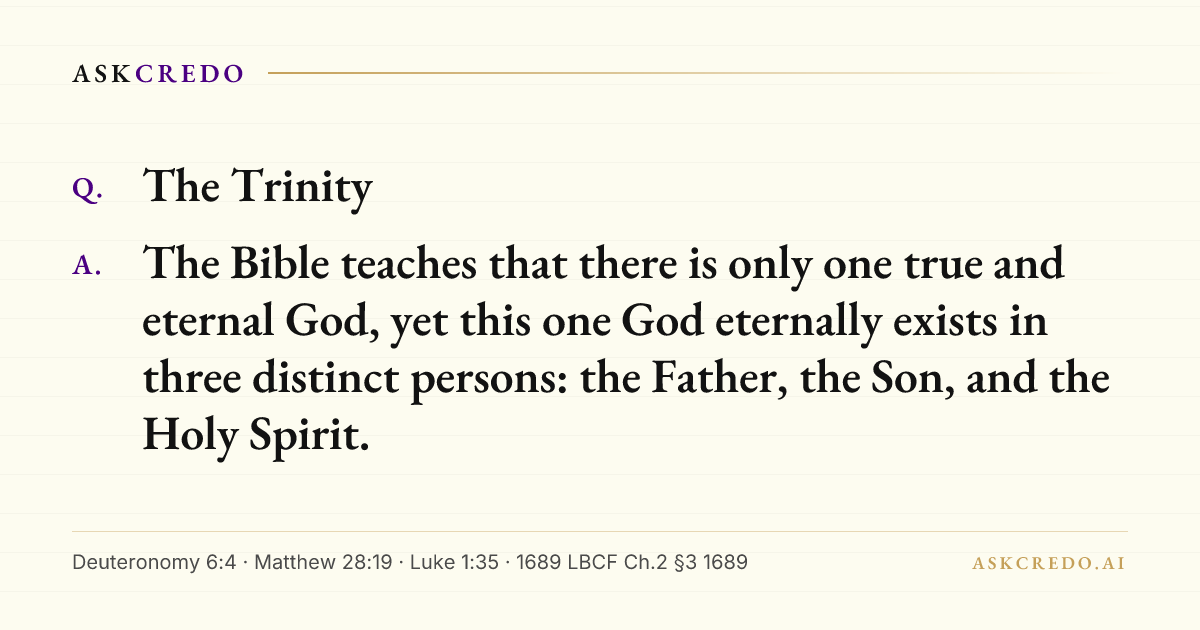
The Bible teaches that there is only one true and eternal God, yet this one God eternally exists in three distinct persons: the Father, the Son, and the Holy Spirit. While this doctrine surpasses human understanding, it is the foundation of the Christian faith, as each person of the Trinity is revealed as fully God, sharing the same divine essence, power, and eternity.
The Unity and Trinity of God
The Scriptures consistently proclaim that there is but one living and true God, yet they simultaneously reveal that within this one infinite Being, there are three subsistences: the Father, the Word (or Son), and the Holy Spirit. As confessed in the 1689 LBCF Ch.2 §3, these three are of one substance, power, and eternity, sharing the undivided divine essence. This truth is anchored in the Old Testament's witness to the unity of God (Deuteronomy 6:4) and confirmed by Christ's explicit command to baptize in the singular name of the three persons (Matthew 28:19).
Sources Deuteronomy 6:4 Matthew 28:19 1689 LBCF Ch.2 §3
The Distinction and Roles of the Persons
Though they are one in essence, the persons of the Trinity are distinguished by their internal relations and their external operations toward us. As noted in the Belgic Confession Art. 9, the Father is our Creator, the Son is our Savior and Redeemer, and the Holy Spirit is our Sanctifier. Scripture demonstrates this distinct action, such as during the incarnation where the Holy Spirit overshadows Mary and the power of the Highest dwells upon her to bring forth the Son (Luke 1:35). This distinction is not a division of God but a beautiful revelation of how God relates to His creation, inviting us into communion with Himself through the work of the Son and the indwelling of the Spirit.
Sources Luke 1:35 Belgic Confession Art. 9
Christians defend the Trinity by pointing to the clear revelation of Scripture that there is but one God who subsists in three distinct persons. They clarify that the term 'person' refers to subsistences within the one divine essence, not three separate gods or parts of God, and they refute objections by showing that the Son and Holy Spirit possess the names, attributes, works, and worship belonging solely to God.
Scriptural Foundation and Divine Names
The defense of the Trinity begins with the recognition that Scripture ascribes the name of God and divine attributes to the Father, the Son, and the Holy Spirit alike. While the word 'Trinity' is not found in the Bible, the truth is clearly taught, notably in the command of Christ to baptize in the singular name of the Father, the Son, and the Holy Spirit (Matt. 28:19). Reformed theology, following the 1689 LBCF Ch.2 §3, maintains that while these three are distinct subsistences with peculiar relative properties, they share one undivided essence. As the Westminster Larger Catechism Q.11 explains, we know they are equal because the Bible assigns to each the unique works and worship that belong to God alone.
Sources Matt. 28:19 1689 LBCF Ch.2 §3 Westminster Larger Catechism Q.11
Clarifying Terms and Refuting Heresy
Objections often arise from a misunderstanding of the word 'person.' Reformed teachers clarify that a person in the Godhead is not a part or a quality, but a subsistence that subsists of itself, yet without dividing the simple essence of God (Institutes 1.13.2). The Augsburg Confession Art. I further reinforces that the Church uses 'person' to distinguish the three without falling into the errors of Samosatenes or Sabellians, who falsely argued that Father, Son, and Spirit are merely modes or manifestations rather than distinct persons. By maintaining this biblical distinction, we avoid both the error of tritheism and the error of modalism, grounding our hope in the God who has truly and eternally revealed Himself in Christ.
Sources Institutes 1.13.2 Augsburg Confession Art. I
Related Questions
See all 10 Theology Proper questions →
You Might Also Explore
Want to explore more?
Ask a question