The Doctrine of Divine Providence
Last updated: 2026-04-10
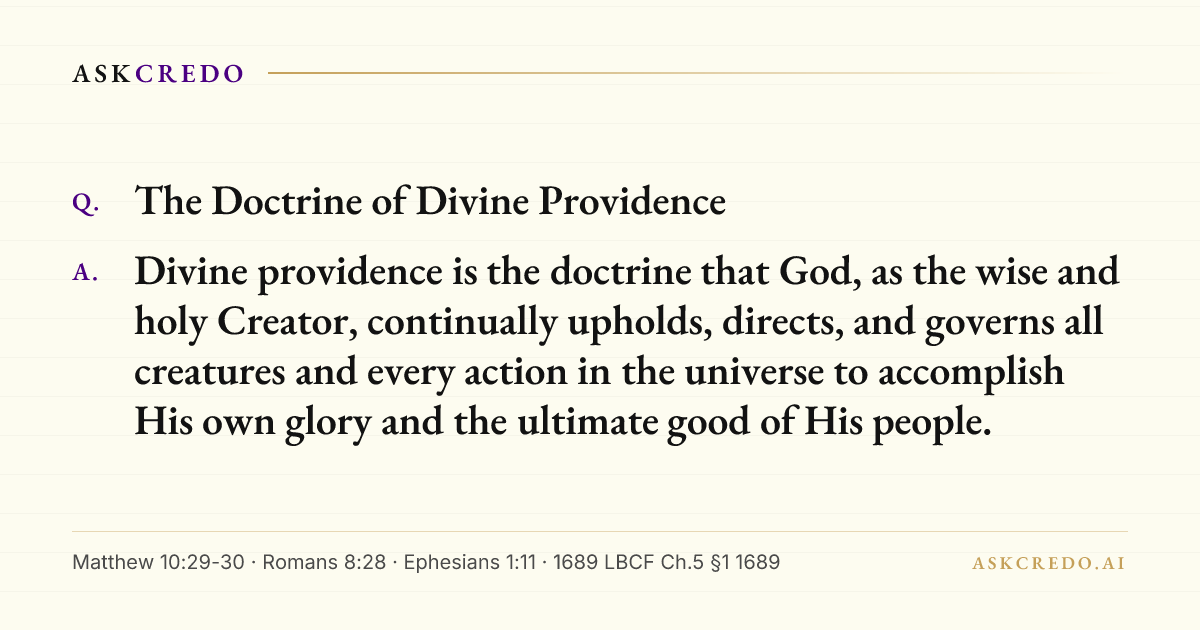
Divine providence is the doctrine that God, as the wise and holy Creator, continually upholds, directs, and governs all creatures and every action in the universe to accomplish His own glory and the ultimate good of His people. While Christians agree on God's sovereignty, there are various nuanced discussions across traditions regarding how this interacts with human responsibility and the specific ordering of temporal events.
📖 God's Sovereign Hand
Divine providence is not merely God observing the world from a distance; it is His active, intimate, and sovereign involvement in all that comes to pass. As the 1689 LBCF Ch.5 §1 declares, God upholds and directs all things—from the movement of stars to the smallest detail of our lives—according to the "free and immutable counsel of his own will." Nothing occurs by chance, but by the "fatherly hand" of God, as noted in the Heidelberg Catechism Q.27. We see this beautifully in Scripture: Ephesians 1:11.
Sources: 1689 LBCF Ch.5 §1 Heidelberg Catechism Q.27 Ephesians 1:11
⛪ Providence for the Church
For the believer, the doctrine of providence is a source of immense comfort. While God governs all creation, He exercises a unique, special care over His Church, disposing all things for the good of His people. This is captured in 1689 LBCF Ch.5 §7. Because Christ has secured our place in God's family, we can rest knowing that even our deepest sufferings are not outside of His loving, providential order. This is the promise of Romans 8:28. We are indeed more accepted and loved in Christ than we ever dared hope, and that love encompasses every detail of our journey.
Sources: 1689 LBCF Ch.5 §7 Romans 8:28
We understand that while God is sovereign over all things, including the suffering and evil in this world, He is never the author of sin. Reformed theology teaches that God wisely ordains or permits these events for His holy purposes and the ultimate good of His people, even when such things remain beyond our full human comprehension.
🛡️ God's Sovereignty and Moral Holiness
The 1689 LBCF Ch.5 §4 affirms that God’s determinate counsel extends to all sinful actions, yet it explicitly states that God is not the author or approver of sin. The sinfulness of these acts proceeds entirely from the creature. This is echoed in the Belgic Confession Art.13, which teaches that even when wicked men act unjustly, God orders and executes His work in a manner that remains perfectly just. We rest in the truth that He uses even the darkest circumstances for His most holy ends.
Sources: 1689 LBCF Ch.5 §4 Belgic Confession Art.13
⚓ Comfort in the Midst of Suffering
Because Christ has finished the work of salvation, we know that our suffering is not random. As the 1689 LBCF Ch.5 §7 notes, God’s providence takes special care of His church, disposing all things for our good. This is a profound comfort, reminding us that we are more accepted and loved in Christ than we ever dared hope, even when we walk through fire. Our Lord Jesus assures us of the Father's intimate knowledge of our lives: Matthew 10:29-30.
Sources: 1689 LBCF Ch.5 §7 Matthew 10:29-30
Related Questions
See all 10 Theology Proper questions →
You Might Also Explore
Want to explore more?
Ask a question