Natural Law
Last updated: 2026-09-08
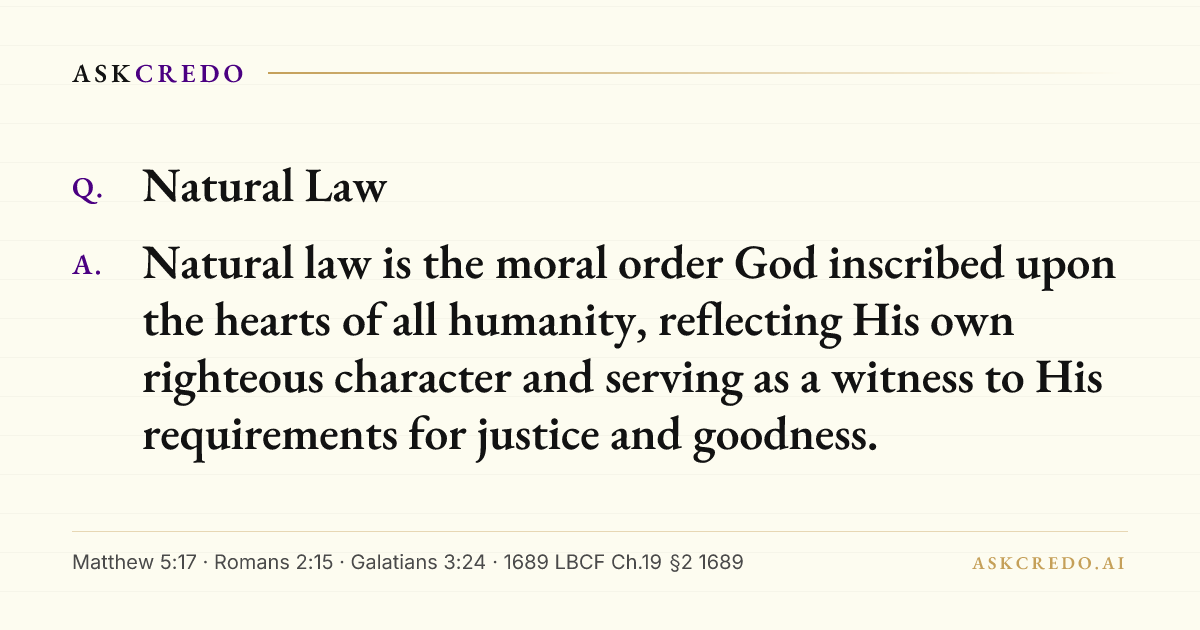
Natural law is the moral order God inscribed upon the hearts of all humanity, reflecting His own righteous character and serving as a witness to His requirements for justice and goodness. While Reformed traditions agree on its reality, they emphasize that it is fully confirmed and clarified by the written moral law found in Scripture, which points sinners to their need for Christ.
Written on the Heart
The concept of natural law refers to the moral principles that God has impressed upon the conscience of every human being. As noted in the 1689 LBCF Ch.19 §2, the law that was first written in the heart of man serves as a perfect rule of righteousness. Similarly, the Second Helvetic Confession Ch.12 teaches that this law of nature was originally inscribed by the finger of God, distinguishing it from the specific ceremonial and judicial laws given to Israel. It acts as a universal witness to God’s holiness, demanding conformity to His will.
Sources 1689 LBCF Ch.19 §2 Second Helvetic Confession Ch.12
A Schoolmaster to Christ
Natural law does not save; rather, it exposes our rebellion against our Creator. Because our sinfulness is profound, our conscience often reflects a distorted image of God's perfect law. As stated in Romans 2:15, the work of the law is written in the hearts of those who do not have the written law. However, because of our total depravity, we cannot fulfill this law by our own strength. Therefore, the law functions as a schoolmaster, as described in Galatians 3:24, to lead us to Christ. In Christ, we receive the righteousness of the law because He perfectly fulfilled its demands and bore our curse on our behalf.
Sources Romans 2:15 Galatians 3:24
In ethics and public life, Christians use natural law as a common moral grammar to advocate for justice and human flourishing, recognizing it as a reflection of God’s character. Because this internal witness is obscured by the fall, Christians rely on Scripture as the final, authoritative standard to clarify moral duties and ultimately point all people toward the necessity of grace in Christ.
A Common Witness to God's Character
Natural law provides a basis for engaging in the public square, as it acknowledges that God has written His moral requirements upon the hearts of all people. As noted in the Second Helvetic Confession Ch. XII, this law was inscribed by the finger of God and helps humanity discern, to a limited degree, what is good and just. It serves as a point of contact in a pluralistic society, allowing for reasoned discourse on justice, even with those who do not share our faith, by appealing to the conscience that God has placed within every human being, as the Apostle Paul articulates in Romans 2:15. By honoring this common moral sense, Christians act as salt and light, promoting structures that favor life, truth, and equity.
Sources Romans 2:15 Second Helvetic Confession Ch. XII
The Necessity of Scriptural Clarity
While natural law provides an initial awareness of morality, it is insufficient for salvation and frequently suppressed by our sinful hearts. Consequently, we look to the written moral law—the Decalogue—to clearly inform us of God’s holy nature and our duty. As the 1689 LBCF Ch. 19 §5 affirms, this law continues to bind all people, not merely by the weight of its content, but by the authority of God the Creator. As the Westminster Larger Catechism Q. 95 notes, the primary use of this law for all men is to humble us, convincing us of our inability to keep it and exposing our need for the perfection of Christ’s obedience. We do not use law-keeping as a ladder to acceptance; rather, we hold up God's holy standard to reveal the gospel's necessity.
Sources 1689 LBCF Ch. 19 §5 Westminster Larger Catechism Q. 95
Ethics Rooted in the Gospel
In all ethical considerations, the Christian’s motivation is fundamentally transformed. We do not obey to become accepted, but because we are accepted in Christ. Christ Himself stated, 'Think not that I came to destroy the law or the prophets: I came not to destroy, but to fulfil' (Matthew 5:17). Because He has fulfilled the law on our behalf, we are set free to pursue righteousness not out of fear of condemnation, but out of gratitude for the grace that has already justified us. Our engagement with public life and ethics is therefore an expression of worship (Soli Deo Gloria), pointing neighbors not just to a better social policy, but to the Savior who alone can recreate the heart.
Sources Matthew 5:17
Related Questions
See all 24 Apologetics questions →
You Might Also Explore
Want to explore more?
Ask a question