Christianity vs. Islam: Key Differences
Last updated: 2026-09-08
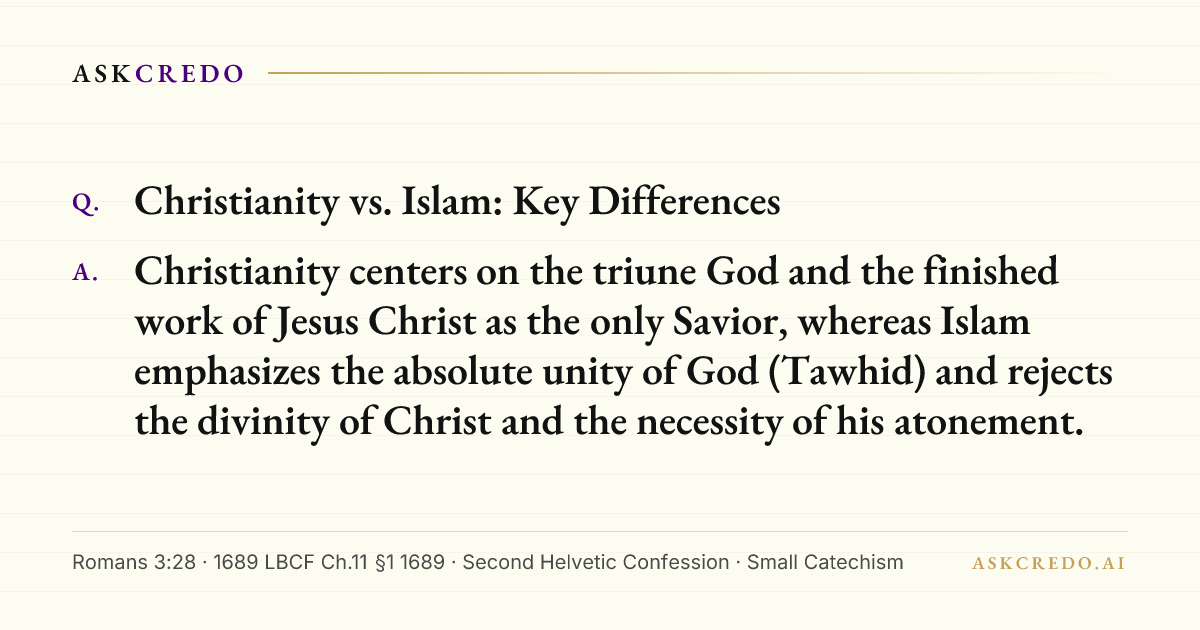
Christianity centers on the triune God and the finished work of Jesus Christ as the only Savior, whereas Islam emphasizes the absolute unity of God (Tawhid) and rejects the divinity of Christ and the necessity of his atonement. While both are monotheistic, they differ fundamentally on the nature of God, the identity of Jesus, and the path to salvation.
The Nature of God: Trinity vs. Tawhid
Christianity teaches that the one true God subsists eternally in three distinct persons: Father, Son, and Holy Spirit (Small Catechism — Question 8). This is not a belief in three gods, but in one indivisible divine nature (Second Helvetic Confession — Ch. III). Conversely, Islam strictly asserts the doctrine of Tawhid, which denies any plurality of persons within the Godhead, viewing the Christian understanding of the Trinity as a compromise of God’s oneness.
Sources Small Catechism — Question 8 Second Helvetic Confession — Ch. III
The Identity and Work of Jesus Christ
The heart of the Christian faith is that Jesus Christ is the eternal Son of God made flesh, the only Mediator between God and man (Second Helvetic Confession — Ch. XI). Scripture declares he died for our sins and rose again, offering full pardon to all who believe. Islam honors Jesus (Isa) as a prophet, but it explicitly rejects his divine sonship and denies that he was crucified for the atonement of sins, viewing such claims as blasphemy (Small Catechism — Question 10).
Sources CHAPTER III, Of God, His Unity and Trinity Question 8 Second Helvetic Confession — Ch. XI Small Catechism — Question 10
The Way of Salvation
Christianity maintains that we are righteous before God only by grace, through faith in the finished work of Jesus Christ (Heidelberg Catechism — Q. 60). In contrast, Islamic tradition teaches a path of submission and obedience to the law and revelations of God, where salvation is generally understood in terms of merit and God’s mercy toward those who perform good works.
Sources Question 80 Heidelberg Catechism — Q. 60
Christianity teaches that salvation is a free gift received solely by faith in the finished work of Jesus Christ, who took upon himself the penalty for our sins, whereas Islam teaches that salvation is attained through submission to God's law and individual performance of good works.
The Root of the Difference
The Christian gospel is fundamentally rooted in the truth that salvation is a work of God alone, not a reward for human merit. In contrast, systems of works-based religion, including Islam, operate on the assumption that man can achieve standing before God through his own obedience. As the Westminster Larger Catechism — Question 60 asserts, those who do not know Christ cannot be saved by their own diligence; there is no salvation in any other name. We maintain, with the Apostle Paul, that a man is justified by faith apart from works of the law, for by works of the law no human being will be justified in God's sight (Romans 3:28).
Sources Westminster Larger Catechism — Question 60 Romans 3:28
Grace vs. Submission
The Reformed tradition—and the Particular Baptist tradition specifically—teaches that we are justified solely by the grace of God through faith in Christ's imputed righteousness. The Second Helvetic Confession — CHAPTER XV explains that we do not share in the benefit of justification partly by the grace of God and partly by our own works or merit, but we attribute it wholly to the grace of God in Christ through faith. While Islam emphasizes submission and the attempt to balance one's scales with good deeds, the gospel announces that the scales have already been tipped by the blood of Christ. As we see in the 1689 LBCF Ch.11 §1, those whom God effectually calleth, He also freely justifieth, not by infusing righteousness into them, but by pardoning their sins, and by accounting and accepting their persons as righteous; not for anything wrought in them, or done by them, but for Christ's sake alone.
Sources CHAPTER XIII, Of the Gospel of Jesus Christ, of the Promises, and of 1689 LBCF Ch.11 §1 Second Helvetic Confession — CHAPTER XV
Related Questions
See all 24 Apologetics questions →
You Might Also Explore
Want to explore more?
Ask a question