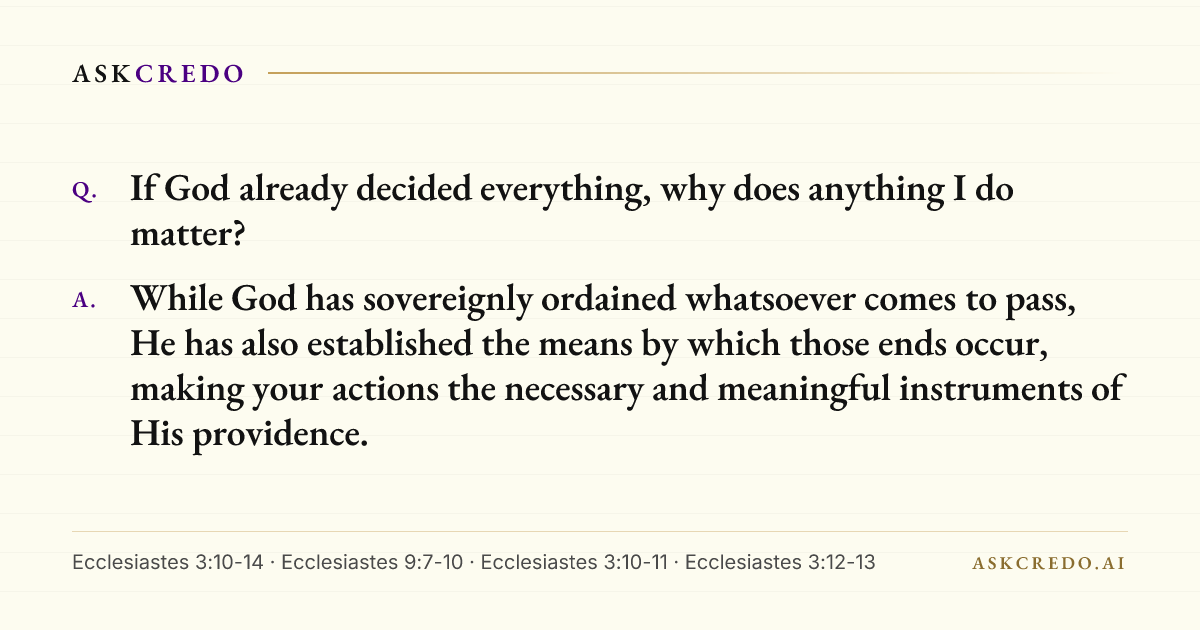
If God already decided everything, why does anything I do matter?
Last updated: 2026-08-14
While God has sovereignly ordained whatsoever comes to pass, He has also established the means by which those ends occur, making your actions the necessary and meaningful instruments of His providence. Your life is not a script you are reading, but a life you are living in total dependence upon the God who works all things for His glory and your eternal good.
⚖️ The Harmony of Decree and Responsibility
The Reformed tradition maintains a high view of God’s sovereignty without ever sacrificing human accountability. As Westminster Confession of Faith Ch.3 §1 teaches, God has indeed foreordained whatsoever comes to pass, but He does so in a way that 'neither is God the author of sin, nor is violence offered to the will of the creatures, nor is the liberty or contingency of second causes taken away, but rather established.' This means your choices are real. You are not a puppet; your decisions are the actual, free expressions of your own heart. Furthermore, 1689 LBCF Ch.5 §2 explains that while all things come to pass immutably and infallibly by God's providence, He nonetheless orders them to fall out 'according to the nature of second causes, either necessarily, freely, or contingently.' Your actions are the second causes through which God accomplishes His perfect plan, giving your life profound significance within His divine architecture.
Sources: Westminster Confession of Faith Ch.3 §1 1689 LBCF Ch.5 §2
⏳ The Meaning of Our Toil
Scripture explicitly addresses the value of human labor within the framework of God's sovereign season-setting. In Ecclesiastes 3:10-11, the Preacher acknowledges the burden God has laid upon men, noting that while He has made everything beautiful in its time and set eternity in human hearts, we cannot fully fathom His work. Yet, precisely because God is in control, we are free to find joy. Ecclesiastes 3:12-13 commands that 'there is nothing better for them than to rejoice and do good while they live,' and that eating, drinking, and finding satisfaction in labor is 'the gift of God.' Your actions matter because they are the context of your worship. Ecclesiastes 9:10 pushes this further: 'Whatever you find to do with your hands, do it with all your might.' This is not a call to toil for your salvation, but an invitation to live with gusto, knowing that your life is held by the One who calls you to delight in the fleeting, precious gift of time.
Sources: Ecclesiastes 3:10-14 Ecclesiastes 9:7-10 Ecclesiastes 3:10-11 Ecclesiastes 3:12-13 Ecclesiastes 9:10
🌱 Faith, Holiness, and the End of Election
It is a common objection that if everything is decreed, there is no need for care or effort. Calvin addresses this directly in Institutes of the Christian Religion 3.23.12, noting that those who use predestination as a 'cloak to evade all admonition' are merely acting like 'swine.' True election does not lead to sloth; it leads to holiness. As the text argues, the end for which we are elected is 'that we should be holy, and without blame before him.' Your life matters because it is the sanctifying work of the Spirit in the elect. If you are struggling with this, look to Christ. Your desire to seek Him, to turn from sin, and to live for Him is not a contradiction of God's sovereignty—it is the evidence of it. Because God has determined your salvation, He has also determined your sanctification. Therefore, your efforts to live a life pleasing to Him are not in vain; they are the fruit of His grace already at work within you.
Sources: Institutes of the Christian Religion 3.23.12
🪨 The Stumbling Stone and the Call to Believe
The tension between divine decree and human response is resolved in the person of Jesus Christ. In Romans 9:30-33, Paul explains that the Gentiles obtained righteousness by faith, while Israel stumbled because they pursued it 'as if it were by works.' Here is the profound reality: God’s sovereign choice does not remove the command to believe. Rather, the 'stumbling stone'—Christ Himself—is the very object of the faith that God grants to His people. Your actions, specifically the act of looking to Christ for your righteousness, are the means by which you embrace the salvation He has ordained for you. You do not come to Christ because you have successfully decoded the hidden counsel of His will; you come to Him because He has called you. This gospel reality cuts off the despair of wondering 'am I elect?' and directs you immediately to the promise: 'the one who believes in Him will never be put to shame.' The certainty of God's purpose is not a reason to be passive; it is the guarantee that your faith is not in vain.
Sources: Romans 9:30-33
Related Questions
See all 34 Soteriology questions →
You Might Also Explore
Want to explore more?
Ask a question