Glorification: The Final Salvation
Last updated: 2026-04-10
What is glorification?
The Short Answer
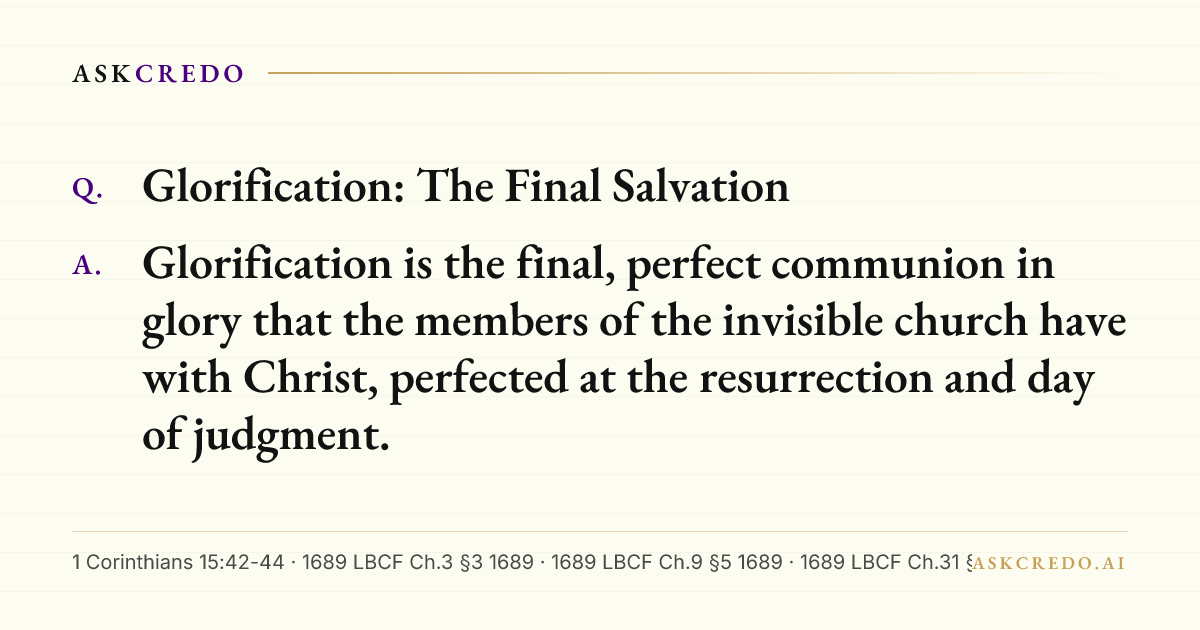
Glorification is the final, perfect communion in glory that the members of the invisible church have with Christ, perfected at the resurrection and day of judgment. It is the end of all the benefits believers receive by the death of Christ, wherein God fully manifests His glory and bestows eternal blessedness upon His people.
The Final Communion
Westminster Larger Catechism — Question 82
The Final Communion
Westminster Larger Catechism — Question 82
In the Reformed tradition, glorification represents the culmination of our union with Christ. As the Westminster Larger Catechism — Question 82 teaches, the communion in glory that the members of the invisible church have with Christ begins in this life, continues immediately after death, and is finally perfected at the resurrection and day of judgment. This is the moment when the work of grace is complete, and believers are fully brought into the eternal fruition of the blessed God.
The Manifestation of God's Glory
1689 LBCF Ch.3 §3, The Death of Death in the Death of Christ
The Manifestation of God's Glory
1689 LBCF Ch.3 §3, The Death of Death in the Death of Christ
The ultimate purpose of our redemption and glorification is the manifestation of God's own glory. As stated in the 1689 LBCF Ch.3 §3, God predestinated some to eternal life specifically for the praise of His glorious grace. John Owen notes in The Death of Death in the Death of Christ that the end of Christ's death is our recovery from the state of misery into eternal communion with God. While we are currently in a state of growing in holiness, we look forward to the state of glory, where, as the 1689 LBCF Ch.9 §5 explains, the will of man is made perfectly and immutably free to good alone.
Sources
4 works cited
Westminster Larger Catechism — Question 82
The communion in glory which the members of the invisible church have with Christ, is in this life, immediately after death, and at last perfected at the resurrection and day of judgment.
External link
1689 LBCF Ch.3 §3
By the decree of God, for the manifestation of his glory, some men and angels are predestinated, or foreordained to eternal life through Jesus Christ, to the praise of his glorious grace; others being left to act in their sin to their just condemnation, to the praise of his glorious justice.
Affiliate link
The Death of Death in the Death of Christ
The end of the death of Christ we asserted, in the beginning of our discourse, to be our approximation or drawing nigh unto God; that being a general expression for the whole reduction and recovery of sinners from the state of alienation, misery, and wrath, into grace, peace, and eternal communion with him.
Affiliate link
1689 LBCF Ch.9 §5
This will of man is made perfectly and immutably free to good alone in the state of glory only.
Affiliate link
What will it look like for believers at the resurrection?
The Short Answer
At the resurrection, the bodies of believers will be raised by the Spirit of Christ, made spiritual and incorruptible, and fashioned like unto His own glorious body. This event signifies the final victory over death, uniting the soul and body forever to enjoy the full presence and glory of God.
A Glorious Transformation
Heidelberg Catechism Q.57, 1689 LBCF Ch.31 §3
A Glorious Transformation
Heidelberg Catechism Q.57, 1689 LBCF Ch.31 §3
The comfort of the resurrection lies in the fact that our bodies, once raised by the power of Christ, will not be merely restored to their former state but will be reunited with our souls and made like unto the glorious body of Christ. According to the Heidelberg Catechism Q.57, this reunion signifies that our mortal, corruptible frames shall be changed, reflecting the very glory of our Savior. The 1689 LBCF Ch.31 §3 confirms that the bodies of the just are raised by his Spirit unto honour, rendering them spiritual and incorruptible. This is not the creation of a new body, but the transformation of the same body that was laid in the grave into a state of perfection, reflecting the Head of the Church, Jesus Christ, in whom we have our resurrection.
The Gospel Assurance
1 Corinthians 15:42-44
The Gospel Assurance
1 Corinthians 15:42-44
This hope is firmly grounded in the gospel. We do not fear the decay of the flesh because Christ has already conquered the grave, serving as the first-fruits of our own resurrection. As the Apostle Paul writes in 1 Corinthians 15:42-44 ASV, 'So also is the resurrection of the dead. It is sown in corruption; it is raised in incorruption: it is sown in dishonor; it is raised in glory: it is sown in weakness; it is raised in power: it is sown a natural body; it is raised a spiritual body.' This is the great promise of the gospel: we who are flawed, sinful, and subject to death are so loved and accepted in Christ that He will perfect us entirely, soul and body, for eternal communion with God.
Sources
3 works cited
Heidelberg Catechism Q.57
That not only my soul after this life shall be immediately taken up to Christ its head; but also, that this my body, being raised by the power of Christ, shall be reunited with my soul, and made like unto the glorious body of Christ.
External link
1689 LBCF Ch.31 §3
The bodies of the unjust shall, by the power of Christ, be raised to dishonour; the bodies of the just, by his Spirit, unto honour, and be made conformable to his own glorious body.
Affiliate link
1 Corinthians 15:42-44 · ASV
So also is the resurrection of the dead. It is sown in corruption; it is raised in incorruption: it is sown in dishonor; it is raised in glory: it is sown in weakness; it is raised in power: it is sown a natural body; it is raised a spiritual body. If there is a natural body, there is also a spiritual [body].
American Standard Version (1901) · Public domainExternal link
Scripture quotations are from the American Standard Version (1901), which is in the public domain.