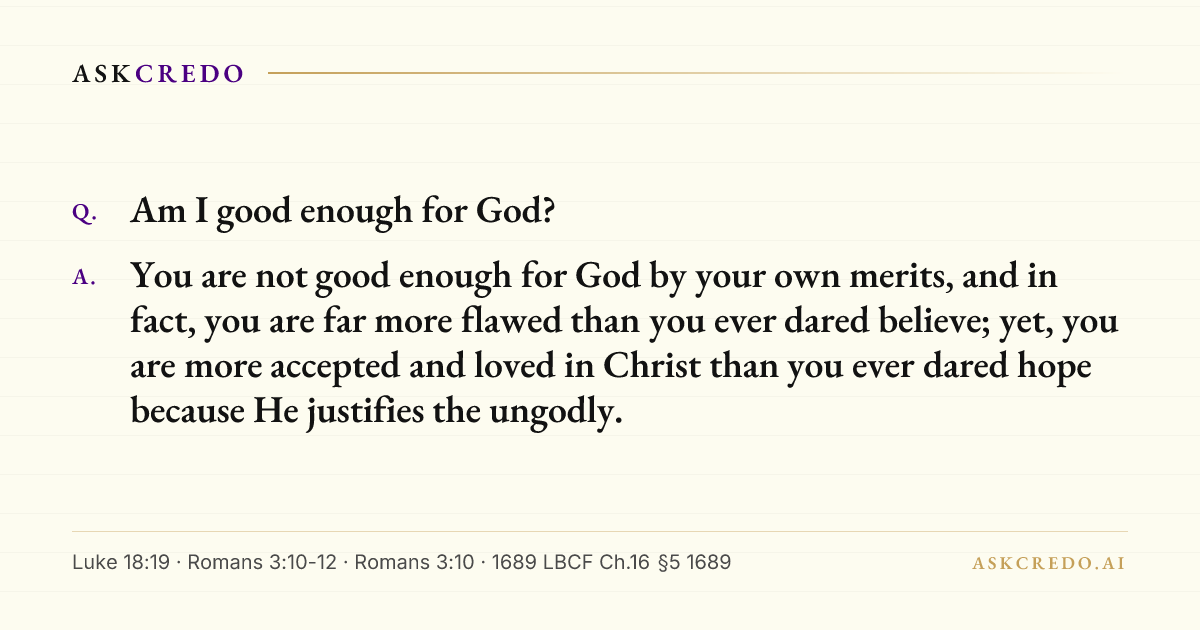
Am I good enough for God?
Last updated: 2026-09-08
Am I good enough for God?
The Short Answer
No one is good enough for God on their own merits, and Scripture says so plainly. But God justifies the ungodly, so that acceptance rests entirely on Christ's righteousness credited to you rather than on your own record.
The Impossibility of Self-Justification
Luke 18:19, 1689 LBCF Ch.16 §5, Westminster Confession of Faith Ch.16 §5
The Impossibility of Self-Justification
Luke 18:19, 1689 LBCF Ch.16 §5, Westminster Confession of Faith Ch.16 §5
The question of human goodness is decisively answered by Christ Himself. When asked about inheriting eternal life, Jesus pointed out that 'none is good, save one, even God' (Luke 18:19 ASV). Reformed theology, as articulated in both the 1689 LBCF Ch.16 §5 and the Westminster Confession of Faith Ch.16 §5, teaches that even our best works are tainted by the weakness and imperfection of our fallen nature. Because of the infinite distance between a holy Creator and sinful creatures, no work we perform can satisfy the debt of sin or merit eternal life. We are, at our absolute best, merely unprofitable servants.
The Gospel for the Ungodly
Romans 3:10-12, All of Grace Ch.3
The Gospel for the Ungodly
Romans 3:10-12, All of Grace Ch.3
Scripture is clear: 'There is no one righteous, not even one' (Romans 3:10 ASV). This reality is not intended to drive us to despair, but to the foot of the cross. As Charles Spurgeon notes in All of Grace Ch.3, the gospel exists precisely because we are unable to save ourselves. God justifies the ungodly, not because they have finally reached a state of 'goodness,' but because Christ has provided a righteousness that is perfect. Salvation is not a reward for the righteous, but a gift for those who recognize their need for a Savior. When you stop trying to 'touch yourself up' to be presentable to God and come to Him in your brokenness, you find that His grace is far greater than your sin.
Also cited: Romans 3:10-12 ASV
Sources
6 works cited
Luke 18:19 · ASV
And Jesus said unto him, Why callest thou me good? none is good, save one, [even] God.
American Standard Version (1901) · Public domainExternal link
1689 LBCF Ch.16 §5
We cannot by our best works merit pardon of sin or eternal life at the hand of God, by reason of the great disproportion that is between them and the glory to come, and the infinite distance that is between us and God, whom by them we can neither profit nor satisfy for the debt of our former sins; but when we have done all we can, we have done but our duty, and are unprofitable servants; and because as they are good they proceed from his Spirit, and as they are wrought by us they are defiled and mixed with so much weakness and imperfection, that they cannot endure the severity of God's punishment.
This establishes that human works are insufficient for salvation due to their inherent imperfection.
Affiliate link · Free-source search opens Google (ads supported)
Westminster Confession of Faith Ch.16 §5
We cannot, by our best works, merit pardon of sin, or eternal life at the hand of God, by reason of the great disproportion that is between them and the glory to come, and the infinite distance that is between us and God, whom by them we can neither profit nor satisfy for the debt of our former sins; but when we have done all we can, we have done but our duty, and are unprofitable servants; and because, as they are good, they proceed from his Spirit; and as they are wrought by us, they are defiled and mixed with so much weakness and imperfection that they cannot endure the severity of God's judgment.
Confirms the universal Reformed consensus on the inadequacy of human works.
External link · Free-source search opens Google (ads supported)
Romans 3:10-12 · ASV
as it is written, There is none righteous, no, not one; There is none that understandeth, There is none that seeketh after God; They have all turned aside, they are together become unprofitable; There is none that doeth good, no, not, so much as one:
American Standard Version (1901) · Public domainExternal link
All of Grace Ch.3
God justifieth the ungodly.
Highlights the central message that justification is for those who lack their own righteousness.
Affiliate link · Free-source search opens Google (ads supported)
Romans 3:10 · ASV
as it is written, There is none righteous, no, not one;
American Standard Version (1901) · Public domainExternal link
Scripture quotations are from the American Standard Version (1901), which is in the public domain.